
Tuna and Green Olive Empanadas (Puff Pastry Version)
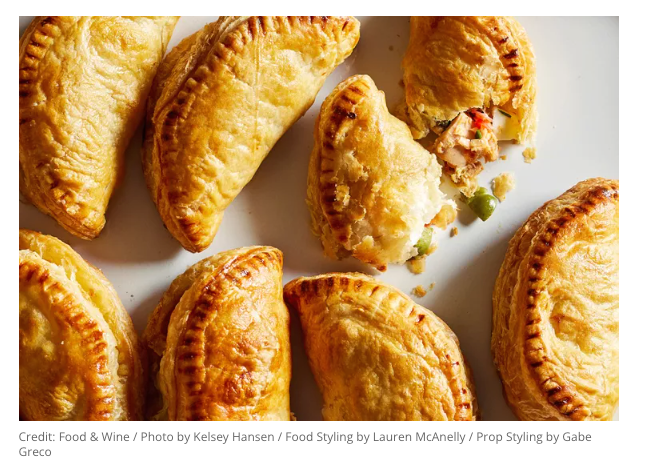
An easy, elegant empanada for home cooks
Tuna and green olive empanadas can feel special enough for guests while still being very manageable in a home kitchen. This approach leans on a few practical shortcuts: canned tuna packed in olive oil for a flavorful, ready-to-use protein, and store-bought puff pastry for a reliably crisp, golden crust without making dough from scratch. The filling is built from cooked tomatoes and onion, scented with pimentón (smoked paprika), then mixed with briny green olives and chopped hard-boiled egg for a classic Spanish combination.
The result is a savory hand pie with a flaky exterior and a rich, balanced interior—salty olives, mellow egg, and tuna tied together by a tomato-onion base. While empanadas can be made in many styles, this particular filling echoes a combination often associated with Spanish traditions, especially those linked to northern Spain.
A note on Spanish context and the filling style
The tuna-olive-egg mixture resembles fillings you might see in an empanada Gallega, a popular dish from northern Spain. In that tradition, the empanada is typically not a small turnover; it is described as a larger, somewhat flat, double-crusted pie. Even so, the flavor profile—tuna with olives and egg—translates naturally into smaller, individual pastries like the ones made here with puff pastry rounds.
Galician empanadas can feature many different fillings. One reference notes that they can range “from clams to rabbit, sardines to pigeon, and octopus to ham.” This variety highlights how adaptable the empanada format can be. In this version, the tuna mixture stays within a familiar, classic combination that is both pantry-friendly and crowd-pleasing.
Why puff pastry works well here
Using store-bought puff pastry is more than a convenience; it also helps deliver consistent results. Puff pastry bakes into distinct layers and browns deeply when handled properly, giving the empanadas a crisp, flaky shell. Because puff pastry is sensitive to warmth, the process benefits from a few temperature-focused steps: cooling the filling before assembly and chilling the formed empanadas before baking. Those steps help the pastry hold its shape and bake up with better structure.
Another advantage is portion control. Cutting the pastry into rounds and filling each with a measured amount (2 tablespoons) makes it easier to seal the edges and reduces the risk of leaks. Leaks can lead to soggy spots where filling escapes and moisture interferes with the pastry’s lift.
Key techniques for a well-sealed, flaky empanada
Even with straightforward ingredients, technique matters. A few small choices can make the difference between empanadas that bake up neatly and ones that split or soften.
- Cook down fresh ingredients: When using fresh ingredients like onion and tomatoes, cooking them first helps reduce excess moisture so the filling is not too watery.
- Cool the filling before assembling: Letting the tomato-onion mixture cool, and then refrigerating the combined filling until cool, prevents steam from softening the dough during assembly.
- Don’t overfill: Keeping to about 2 tablespoons of filling per pastry round helps you seal the edges properly and discourages leaks.
- Chill before baking: Refrigerating the assembled empanadas helps maintain structural integrity in the oven, which is especially helpful with puff pastry.
- Seal decoratively and firmly: Pressing the edges to seal and crimping with the tines of a fork helps create a secure closure and a finished look.
Ingredients highlighted in this version
The ingredient list is designed to be accessible while still delivering depth of flavor. Tuna packed in olive oil brings richness, and pimentón adds a smoky warmth to the tomato base. Green olives contribute briny contrast, while hard-boiled egg adds a mild, savory softness that rounds out the filling.
- Pimentón (smoked paprika): Used to scent the tomato mixture and add a distinct smoky note.
- Tuna packed in olive oil: Drained and lightly broken up before mixing, it becomes the main protein in the filling.
- Cooked tomatoes and onion: Simmered together to concentrate flavor and reduce moisture.
- Green olives: Briny and firm, they punctuate the filling with salt and tang.
- Hard-boiled egg: Chopped and folded in for a classic pairing with tuna.
- Puff pastry: Store-bought sheets are cut into rounds, rolled slightly larger, filled, folded, and baked until deep golden brown.
Step-by-step method (overview)
This process is best thought of in three phases: make a concentrated tomato-onion base, combine and chill the filling, then assemble and bake the empanadas. The chilling steps are not just waiting time; they support the pastry’s final texture.
- Cook the onion: Heat olive oil in a large skillet, then cook onion with a bay leaf over moderate heat, stirring occasionally, until softened (about 12 minutes).
- Add tomatoes and pimentón: Cook with the onion, stirring occasionally, for about 10 minutes, then remove from heat and let cool. Discard the bay leaf.
- Mix the filling: Lightly break up drained tuna in a bowl, then add green olives, chopped hard-boiled egg, and parsley. Stir in the cooled tomato-onion mixture, season with salt, and refrigerate until cool (about 30 minutes).
- Prepare the pastry rounds: Unfold puff pastry sheets on a lightly floured work surface. Cut into 12 rounds using a 4 1/2-inch cutter, then roll each round to about 5 inches in diameter.
- Fill and seal: Spoon 2 tablespoons of filling onto one side of each round, fold over, and press edges to seal decoratively with a fork.
- Chill the formed empanadas: Place on parchment-lined baking sheets (6 per sheet), cover with plastic wrap, and refrigerate for at least 30 minutes.
- Egg wash and bake: Preheat oven to 400°F with two racks in the center. Whisk egg with milk, brush over empanadas, then bake about 30 minutes until deep golden brown. Cool for 5 minutes before serving.
Planning ahead: storage and make-ahead options
These empanadas are friendly to advance prep, which can be helpful for entertaining or for spreading the work across a couple of days. The unbaked empanadas can be wrapped in plastic and refrigerated for up to two days. They can also be frozen for up to one month. Because puff pastry benefits from being cold when it goes into the oven, baking from a well-chilled state supports the goal of a crisp, flaky crust.
The filling itself is also practical. This recipe makes more filling than is needed for the empanadas, which can be a bonus rather than a complication. Leftover filling can be repurposed in simple ways without requiring additional elaborate prep.
How to use leftover filling
If you have extra tuna, olive, and egg filling after forming the pastries, it can be used beyond empanadas. Two suggested options are particularly straightforward and keep the flavors in a similar snack-or-meal zone.
- As a topping for crostini: Spoon the mixture onto crisp crostini for an easy appetizer-style bite.
- Tossed with pasta: Use the filling as a quick pasta topping for an easy weeknight dinner.
Serving ideas and a simple pairing
These empanadas are best served after a brief rest—about five minutes—so the filling settles and the pastry is easier to handle. They work as an appetizer, a light lunch, or part of a larger spread. Because the filling includes tuna in olive oil, tomatoes, olives, and egg, it has both richness and briny intensity.
For a drink pairing, a crisp Spanish white wine is suggested to complement the savory filling. Two options mentioned are Albariño or a Sauvignon Blanc blend. The emphasis is on freshness and brightness to balance the empanadas’ rich, savory character.
Recipe details (as provided)
Below are the key measured items and specific instructions included with the recipe. The method relies on cooling and chilling steps to protect puff pastry texture.
- 1/2 rounded teaspoon pimentón (smoked paprika)
- 1 (6-ounce) can tuna packed in olive oil, drained
Heat the olive oil in a large skillet. Add the onion and bay leaf and cook over moderate heat, stirring occasionally, until the onion is softened, about 12 minutes. Add the tomatoes and pimentón and cook, stirring occasionally, for 10 minutes. Remove from heat and let cool. Discard the bay leaf.
In a bowl, lightly break up the tuna. Add the olives, chopped egg, and parsley, and stir in the tomato-onion mixture. Season with salt and refrigerate until cool, about 30 minutes.
Unfold the puff pastry sheets on a lightly floured work surface. Using a 4 1/2-inch biscuit cutter, cut the pastry into 12 rounds. Using a rolling pin, lightly roll out each round to a 5-inch diameter.
Spoon 2 tablespoons of the tuna filling onto 1 side of each pastry round. Fold the pastry over the filling and press the edges to seal decoratively with the tines of a fork.
Line 2 baking sheets with parchment paper and set 6 empanadas on each sheet. Cover with plastic wrap and refrigerate for at least 30 minutes, or until chilled.
Preheat the oven to 400°F and place 2 racks in the center. In a small bowl, whisk the egg with the milk. Lightly brush the empanadas with the egg wash. Bake for 30 minutes, or until the empanadas are deep golden brown. Let cool for 5 minutes before serving.
What to expect when they come out of the oven
When baked properly, the empanadas should be deep golden brown with visibly flaky layers. Inside, the filling should be richly flavored but not watery, with distinct bites of olive and egg throughout the tuna and tomato-onion mixture. The combination of cooling the filling, measuring the portion, sealing well, and chilling before baking is designed to keep the pastry crisp and the edges intact.
Because they are made in individual portions, these empanadas are easy to serve and store, and the same filling can also be enjoyed in other simple formats like crostini or pasta.