
Fog Harvesting in Chile’s Atacama Desert: A Low-Energy Approach to Supplement Drinking Water
Why water scarcity is pushing researchers to look at fog
In many places, especially during snowy or rainy seasons, it can be hard to picture a world where water becomes increasingly scarce. Yet global water challenges are already widespread. More than two billion people lack access to safe drinking water, and about half of the world experiences severe water scarcity for several months each year. Over the past two decades, terrestrial water storage—including soil moisture, snow, and ice—has declined by about 0.4 inches per year. These pressures are expected to increase, with climate change and population growth contributing to the strain.
Against this backdrop, scientists are exploring water sources and collection methods that may have been overlooked or treated as niche solutions. One approach drawing renewed attention is fog harvesting: capturing tiny water droplets suspended in fog and turning them into usable water. While fog harvesting has been discussed for years in various forms, recent research suggests it may have more practical potential for communities than previously assumed—if the conditions are right.
A field study in one of the driest places on Earth
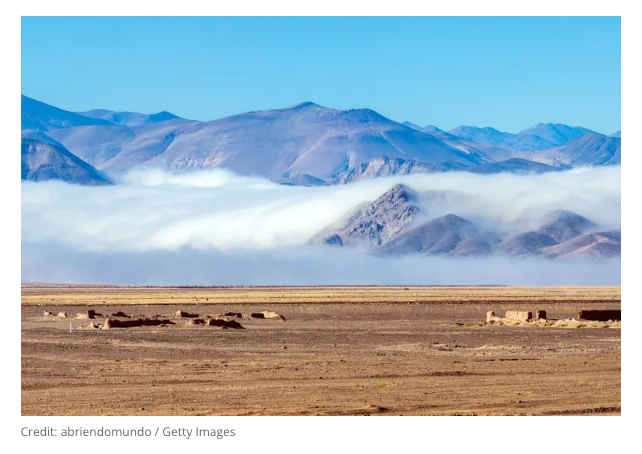
Chile’s Atacama Desert is known for its extreme aridity. Near Alto Hospicio in the Atacama Desert region, rainfall is exceptionally low—less than 0.2 inches per year. This makes the region a compelling place to test whether fog can meaningfully supplement water supplies.
In 2025, researchers from Chile released findings from a year-long field study examining whether fog around Alto Hospicio could be harvested at levels that matter for communities. The research focused on practical collection rates and site suitability, aiming to understand not only whether fog harvesting works, but also what scale might be required to make a measurable difference.
How fog harvesting works: simple materials, straightforward design
The core technology used in the study is relatively simple. Fog collectors consist of pieces of mesh suspended between two posts. As fog moves through the area, airborne droplets collect on the mesh. Over time, the droplets coalesce and drip downward into a gutter system. The gutters then drain into water storage tanks.
One notable feature of this method is that it requires no extra energy output. The system relies on natural movement of fog and gravity to move collected water into storage. This low-energy aspect is part of what makes fog harvesting attractive as a complementary approach, particularly in dryland settings where water systems can be costly or difficult to expand quickly.
What the researchers measured: collection rates and potential community impact
Over the course of the year-long study, the research team found they could collect up to 10 liters per square meter per day under the best observed conditions. Based on those results, they estimated that fog water could be sufficient to supplement the water supply for a community of about 10,000 people, supporting irrigation, agriculture, and human consumption.
The findings were framed as a shift in how fog water might be perceived and used. Rather than being limited to rural or small-scale applications, the research suggests fog could be treated as a practical complementary water resource for cities—at least in certain dryland environments where fog is present and can be captured consistently.
As described by Dr. Virginia Carter Gamberini, an assistant professor at Universidad Mayor and first co-author of the study published in Frontiers in Environmental Science, the work reflects a change in perspective: from seeing fog harvesting as a small-scale rural solution to considering it as a resource that could support urban areas. The research also positions fog as a potential complementary supply in drylands where climate change can exacerbate water shortages.
Site conditions matter: where the system worked best
The study also highlighted an important limitation: not every location performed equally well. Significant water-collection levels were observed only at the region’s higher-altitude sites, just outside the city limits. This point is crucial for understanding fog harvesting as a strategy. The method may be straightforward, but its performance depends heavily on local geography and weather patterns.
Fog density and wind patterns influence how much water can be captured. In other words, even within the same broader region, some sites may be far more productive than others. The research suggests that fog harvesting is not a one-size-fits-all solution; it requires careful siting and realistic expectations about output.
Scaling up: how much mesh would be needed?
Beyond maximum daily collection rates, the researchers also considered average performance and what it would take to meet broader demand. Using an average water-collection rate of 2.5 liters per square meter per day, they calculated that about 17,000 square meters of mesh would be required to produce enough water to meet the region’s total weekly water demand. That area is roughly 4.2 acres of mesh.
This calculation illustrates both the promise and the practical challenge of fog harvesting. On one hand, the method can produce meaningful volumes of water without additional energy input. On the other hand, meeting large-scale demand could require substantial collector area, along with the infrastructure to route, store, and manage the collected water.
From rural tool to urban supplement: what “complementary supply” means
The study’s emphasis on fog as a complementary urban water supply is an important framing. It does not position fog harvesting as a total replacement for existing water systems. Instead, it suggests fog can supplement supplies—adding resilience in places where water shortages are becoming more frequent or severe.
In practical terms, “complementary” can mean several things within the scope of the research findings:
Providing additional water for irrigation and agriculture when other sources are limited.
Supporting human consumption needs as part of a broader mix of water sources.
Offering a renewable source that can be integrated into planning where conditions allow.
Because the method relies on naturally occurring fog, it is inherently tied to local climate patterns. The research therefore points toward targeted use: deploying collectors where fog is reliable and collection rates justify the infrastructure footprint.
The “Goldilocks conditions” required for fog harvesting
For fog harvesting to work well in other arid locations, the study notes that the sites would need “Goldilocks conditions.” In this context, that means environmental factors must align: the right fog density and wind patterns are needed for droplets to accumulate on mesh at useful rates.
This is a practical takeaway for planners and policymakers. Fog harvesting may be renewable and low-energy, but it is not universally applicable. The most productive deployments are likely to be those where fog is frequent enough and moves through collection sites in a way that supports consistent capture.
Policy relevance: integrating fog into water strategies
While the study is grounded in field measurements and site-specific results, it also points toward broader planning implications. The researchers expressed hope that policymakers will consider integrating fog harvesting into national water strategies. The rationale is that adding a renewable source could enhance urban resilience to climate change and rapid urbanization, while improving access to clean water.
This policy-oriented message does not assume fog harvesting can solve water scarcity on its own. Instead, it suggests that where the conditions are favorable, fog harvesting can be part of a diversified approach—one that combines multiple sources and methods to reduce vulnerability during periods of shortage.
Key takeaways from the Atacama study
The year-long research effort near Alto Hospicio offers a set of grounded conclusions about what fog harvesting can and cannot do, based on observed collection rates and site constraints:
Fog can be captured using simple infrastructure. Mesh suspended between posts can collect droplets that drain into gutters and storage tanks.
The method requires no extra energy output. Collection and drainage rely on natural fog movement and gravity rather than powered systems.
Output can be meaningful under the right conditions. The study observed collection rates up to 10 liters per square meter per day.
Average rates imply significant scale for large demand. At an average of 2.5 liters per square meter per day, meeting total weekly demand would require about 17,000 square meters (about 4.2 acres) of mesh.
Location is critical. Significant collection occurred at higher-altitude sites outside the city limits, underscoring the need for careful siting.
Fog harvesting is best viewed as a supplement. The research frames fog as a complementary urban water supply in drylands, not a standalone replacement.
What this approach represents—and what it does not
The Atacama findings present fog harvesting as a practical, renewable option that can contribute to water resilience in specific dryland settings. The system described is not complex: mesh, posts, gutters, and storage tanks. Yet the results suggest that, under favorable conditions, these basic components can yield water volumes that are relevant to community needs.
At the same time, the study’s caveats are central to any realistic understanding of the method. Performance depends on geography and local weather dynamics, and scaling to meet large demand requires significant collector area. These constraints do not negate the value of fog harvesting; rather, they define where and how it can be responsibly considered.
Ultimately, the research is presented as a start—evidence that fog can be treated as more than a small-scale rural tool, and that it may have a role in broader water planning where the “Goldilocks conditions” exist. For regions facing increasing pressure on water supplies, that possibility is one more option to evaluate alongside other strategies aimed at improving access to clean water.